

Brewing and Distilling - Making hop gin with a beer-making mindset -
My name is Sota Oshima, and I distill gin in Fukushima.
Before this, I used to brew beer.
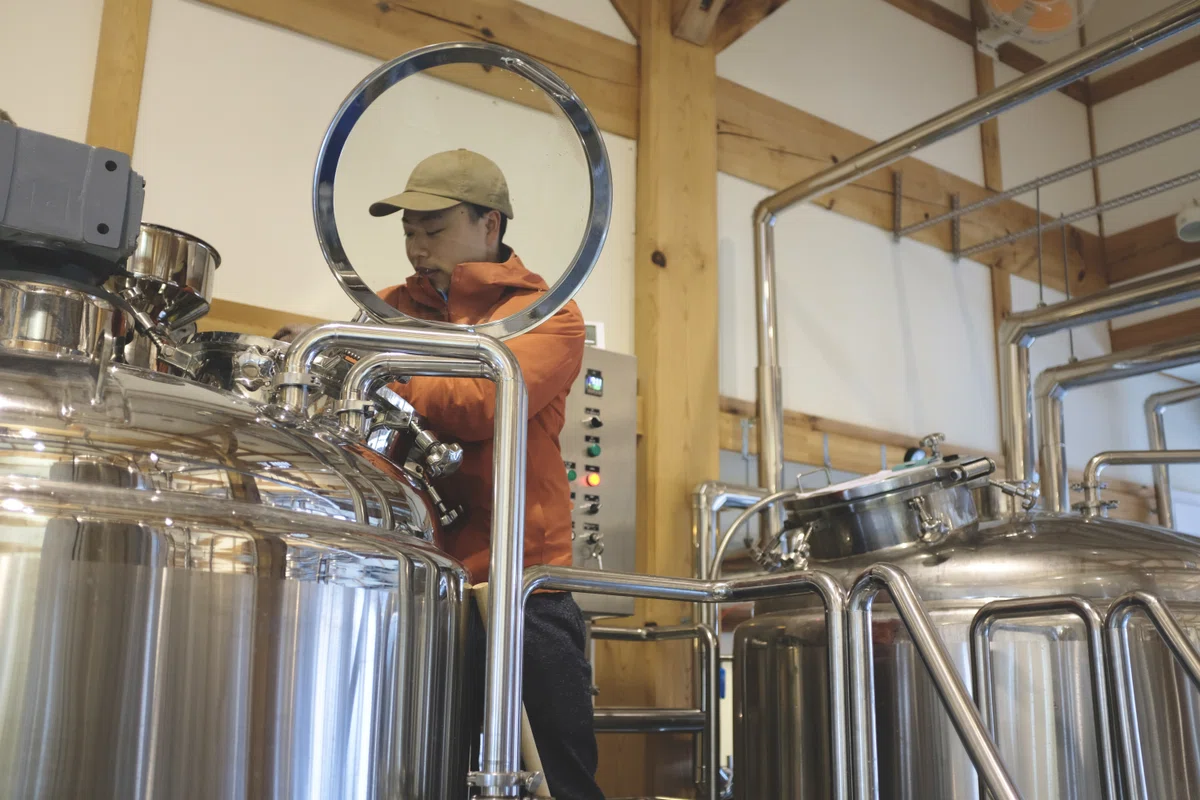
When I was brewing beer at Hop Japan

Beer is an alcoholic beverage made from malt, hops, water, and yeast.
Alcohol and flavor are created by saccharifying malt and fermenting it with yeast.
Among these, hops largely determine the unique aroma and bitterness.
So last summer, we used hops and applied our beer brewing philosophy to create gin.
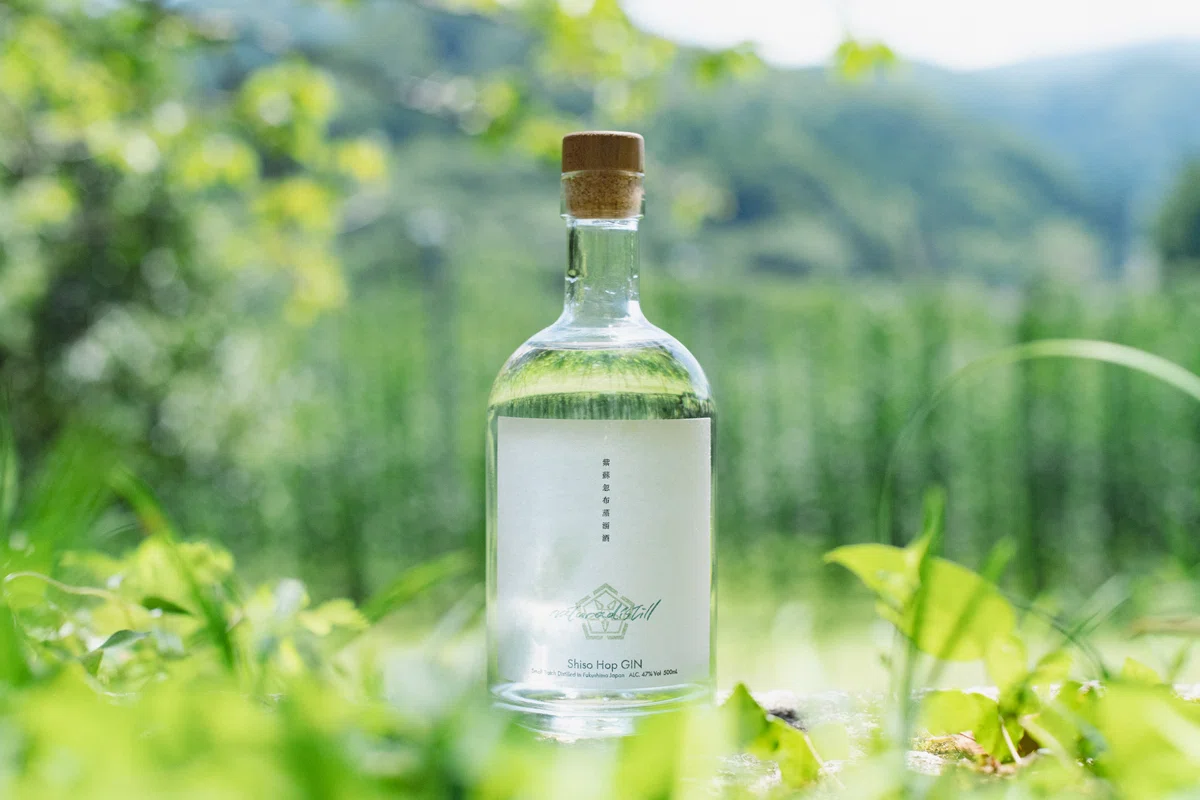
Shiso Koppu Distilled Spirit. The background reflected in the bottle is a hop field.

While gin made with hops already exists both domestically and internationally, we wondered if we could further enhance the qualities of hops.
I will outline our design philosophy here.
What are Hops?
Hops are climbing perennial plants belonging to the Cannabaceae family that not only provide aroma and bitterness to beer but also have antiseptic and antimicrobial properties.
The part used is the flower, known as the "marihana" (hop cone), and within it, yellow granules called lupulin contain the components responsible for aroma and bitterness.
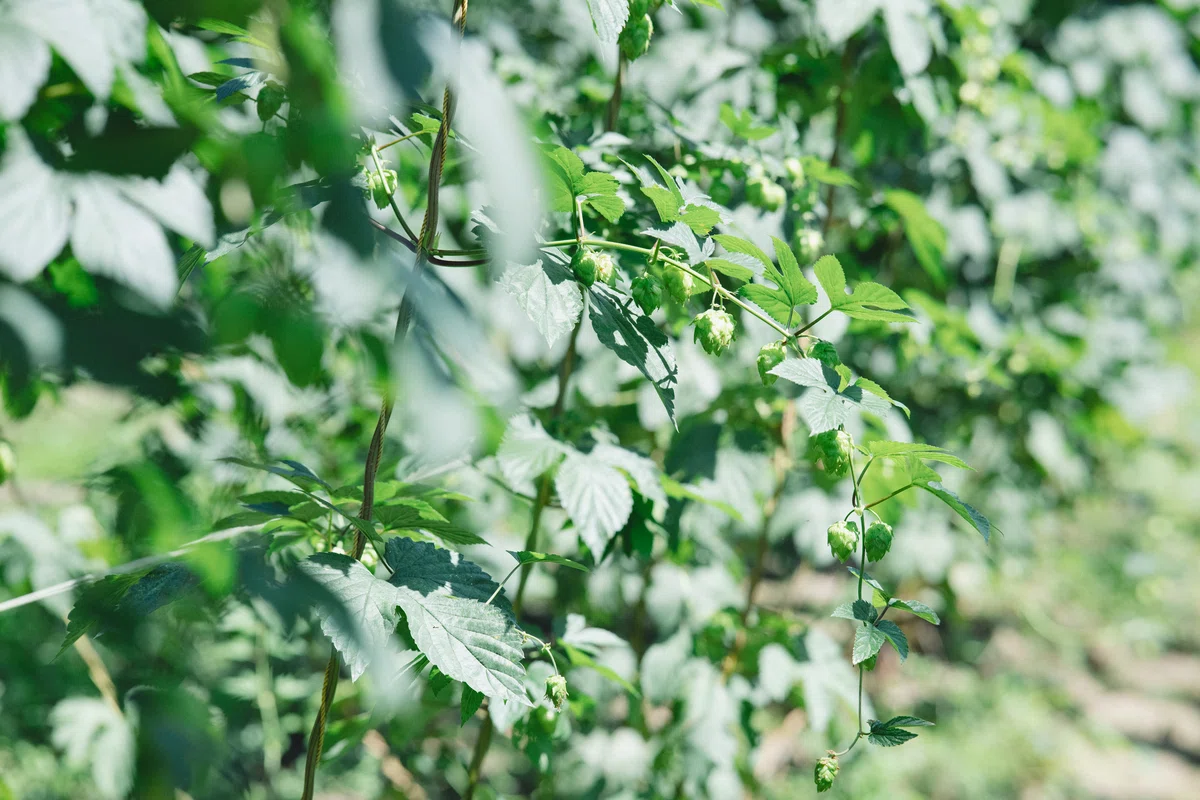
A hop field in Tamura City, Fukushima Prefecture, 30 minutes from the distillery.

There are hundreds of hop varieties, and in beer brewing, their individual characteristics are utilized, with some being better suited for bitterness and others for aroma.
Also, the raw material comes in various forms.
There are fresh hops used as-is, dried hops, crushed and compressed pellets, and CRYO hops, which are separated and concentrated lupulin parts at low temperatures.
Hops in Beer
In beer, hops primarily serve two roles.
One is for bitterness, added during the boil (hot side).
The other is for aroma, added during the latter half of fermentation (cold side).
The crucial point here is that the compounds extracted vary depending on the temperature.
At high temperatures, alpha acids, which are bitter compounds, isomerize, creating a firm bitterness, while delicate, volatile aromas tend to be lost.
Conversely, at low temperatures, alpha acid isomerization hardly occurs, so bitterness is less likely to develop, and instead, delicate aromas such as citrus and tropical can be preserved.
Applying Boiling Point Differences to Gin Production
In the production of "Shiso Koppu Distilled Spirit" gin this time, we used two types of hops. By individually steeping and distilling each, we built up layers of aroma.
-
Fresh hops (Centennial)
→ Distilled at relatively high temperatures to extract rich nuances such as grassiness and resinous notes derived from hops. -
CRYO hops (Cascade)
→ Distilled at low temperatures to extract light aromas like citrus and floral notes.
Our distiller can handle both reduced pressure and atmospheric pressure, allowing us to control the boiling temperature of the alcohol and water mixture from about 20°C to 78°C.
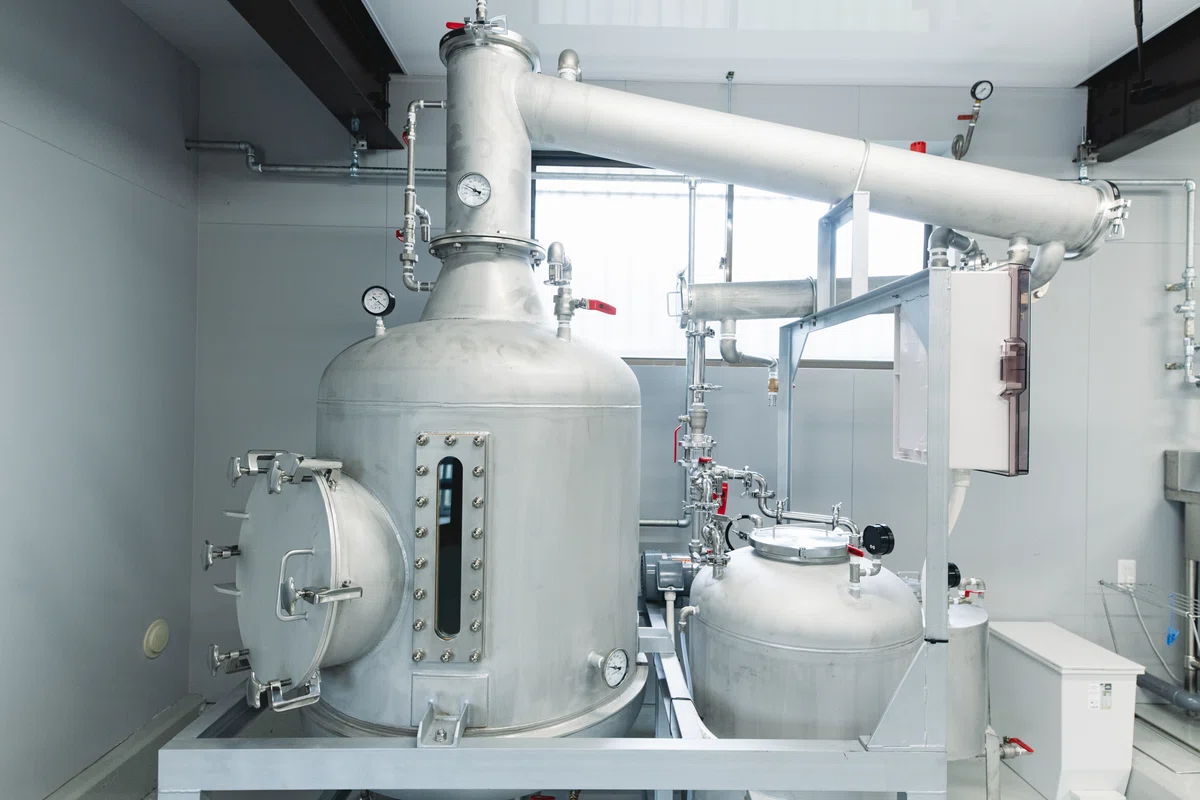
Naturadistill's still

This can be seen as applying the design philosophy of the hot and cold sides in beer to distillation.
Creation and Extraction - The Big Difference Between Brewing and Distilling
The biggest difference between beer (brewing) and gin (distilling) lies in how their aromas are created.
In beer, aromas are "generated" through the action of yeast and enzymes.
Aromas change and develop over time.
On the other hand, in gin, the key is how to extract existing aromas from plants without damaging them.
In other words, the aroma in gin is "extracted," not "generated."
The main focus of the design shifts from time and microorganisms to temperature and pressure.
Herein lies the significant difference between brewing and distilling.
"Generating" Beer Aroma - Biotransformation
One of the fascinating aspects of beer brewing is biotransformation.
This is the phenomenon where yeast acts on hop-derived compounds, converting them into different aromas.
For example,
・Geraniol → Citronellol (a more citrus-like aroma)
such changes occur.
In other words, in beer, the aroma of hops is not expressed as is, but rather it is reconstructed by yeast.
This is a characteristic unique to brewed alcoholic beverages, and in recent years, craft sake that utilizes this phenomenon has also emerged.
On the other hand, such a transformation essentially does not occur in gin.
That is precisely why it is crucial to extract the inherent aromas of the ingredients with high precision.
"Extracting" Gin Aroma - Alcohol Maceration and Cuts
In gin production, the processes that differ significantly from beer brewing are the "maceration" of botanicals and the "cuts" during distillation.
During maceration, aromatic compounds from botanicals are dissolved into alcohol.
Here too, the compounds extracted change with time and temperature.
And during distillation,
・Heads (lightly volatile compounds)
・Hearts (core aromas)
・Tails (heavy compounds that can cause off-flavors)
are separated and collected.
Where to use and where to cut.
We check this with our nose and tongue.
Making this judgment with human sensory organs greatly influences the clarity and depth of the final product.
Finally
Applying the concept of extracting aromatic components from plants, cultivated in beer brewing, to distillation rather than fermentation.
Understanding the differences in boiling points, separating extraction conditions, and constructing aromas in layers.
This led to one form of gin made with hops.
Going forward, we will continue to explore the possibilities of gin aromas by applying various techniques to distillation.